Showing posts with label Obituaries. Show all posts

Wednesday, May 1, 2019

In memorium: Henry Horn

In the acknowledgements section of my PhD defence, I drew Henry as a male satin bowerbird, as a tribute to his inventiveness, artistry and intelligence. By analogy, bowerbirds are also much less personally showy than their posturing relatives, the birds of paradise. Henry is easily the most unassuming yet brilliant people I have ever known.

He is also a great inspiration to those who are equally inspired by the art in science and nature as by the nature of art. There is no better embodiment of a Renaissance man than Henry Horn. Inventor, naturalist, mathematician, artist, poet, musician, craftsman, beloved teacher, environmentalist, humorist, lifelong explorer of the natural world.

I have never met another person who so genuinely enjoyed sharing his diverse passions with others, yet managed to make anyone feel as though each conversation with him was a comfortable, cosy chat between kindred spirits. Henry always made one see the humour in a situation and to think deeply. This is probably because of his consummate ability to do both simultaneously. The door to his office was covered in jokes, often against himself. There was a copy of a letter threatening failure at Harvard if he didn't pull up his socks academically. Also a photograph of himself at a more tender age, with a caption along the lines of "such a cute kid, where did it all go?". Once you entered, he would have original and thoughtful comments on any subject.

Some of the best pieces of advice on writing comes from Henry, and I pass it on to students all the time. 1. Read good writing, and lots of it. Preferably Jane Austen. 2. Read what you've written aloud, and if you stumble, that's a sure sign the sentence is clumsy.

There are far too many memories to list, but I speak for assorted strays and aliens who benefitted from Henry and Betty's hospitality at Thanksgiving. Their beautiful home at Stony Ford was where I had the pleasure of first encountering J. Chester's gallery and the LiWA, short for Little Wooden Animals, which accompanied him and Betty to some spectacular places. I am also personally grateful to Henry for choosing my book prize when I graduated from EEB. The last time I visited him, he showed me his children's books and lesson plans with the LiWA as protagonists, played the guitar, and showed me the new public library building at Princeton, all on top of discussing bird behaviour over Subway sandwiches.

Unlike many scientists of his stature, Henry had a deep and abiding respect for all students of nature. He spent so much time teaching and exploring with everyone, from schoolchildren to lost undergraduate and graduate students, that his intellectual legacy through other minds is immense. Now that I can no longer pop in for a chat, every memento and memory of Henry will be all the more precious. I shall be taking a walk in the woods this Sunday as I can't attend his memorial service.


Wednesday, October 19, 2016

In memoriam: Stuart A. Altmann


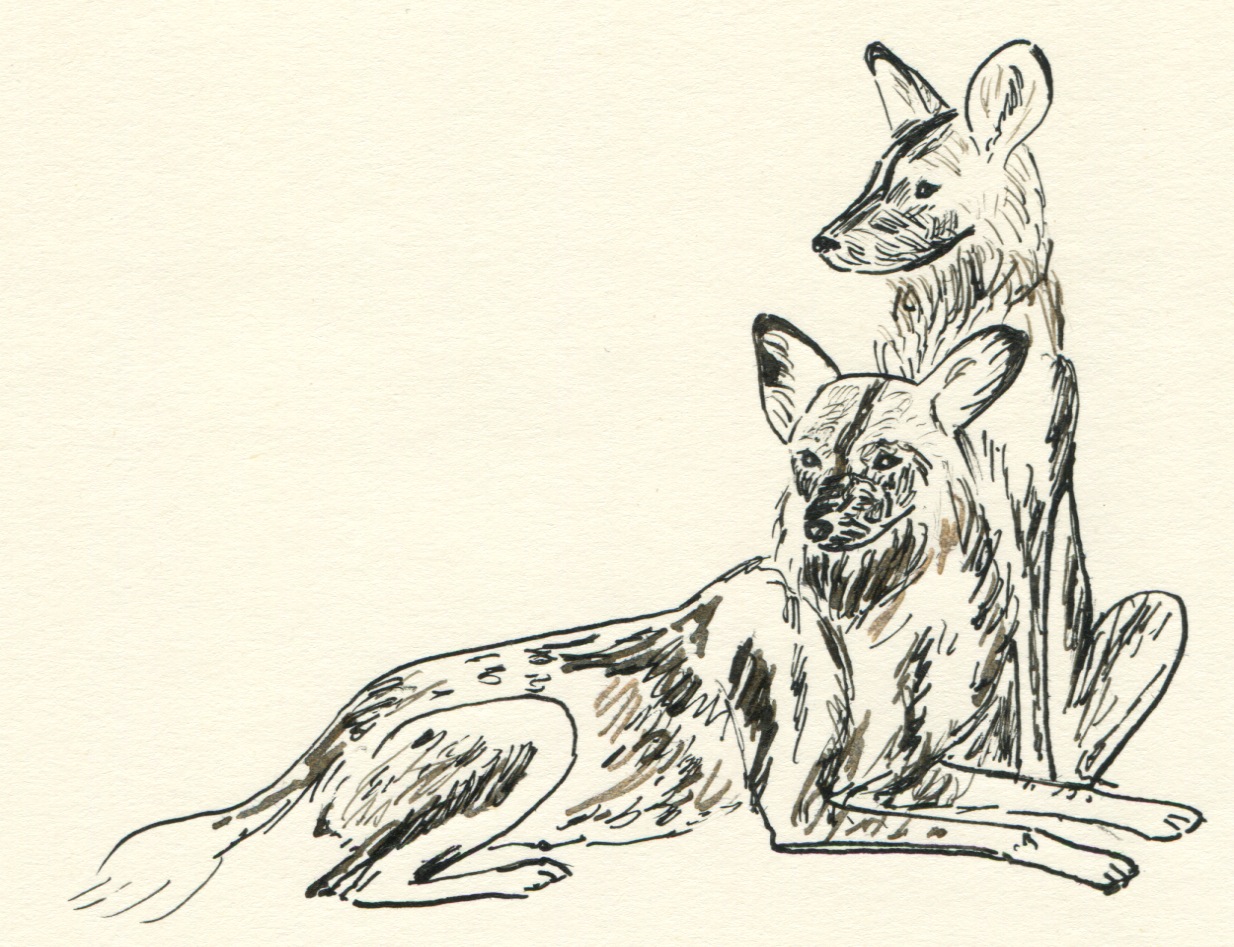
Stuart and Jeanne as highly intelligent, organised, energetic and devoted partners, parents and pack leaders.
Stuart Altmann was extraordinarily brilliant, kind and full of life. Though I think he would agree that Jeanne Altmann probably surpasses him in these qualities, I know of no more exceptional and inspiring people, whether individually or to quote Stuart’s obituary, as a couple in “rich, intellectual partnership”.

Stuart had many passions, and loved to share them. Some of my favourite memories are of him enthusiastically introducing me to proper mole at an Oaxacan restaurant, or whipping up a batch of sourdough waffles from his own decades old sourdough starter, while discoursing on meticulously labelled varieties of cider from the orchard he has lovingly stocked with heirloom apples. Not once, throughout the making and eating of breakfast, did Stuart ever take Jeanne for granted. This would sound sappy if it weren’t so invariably true of both of them, but even when asking his wife to “please pass the salt”, Stuart was genuinely grateful and honoured to be asking her. He liked to relate an anecdote about how his children would come home from school and ask why their parents were so abnormal as to never be seen arguing. I gather they did occasionally disagree, as he also said that since Jeanne was always right about people, he’d long ago given up objecting to her choice of field assistants. They did agree that marrying each other was “the best decision I ever made”.

The baboon project Stuart and Jeanne began in Amboseli is the stuff of legend. I loved to visit Stuart’s office in Eno Hall at Princeton, where he would talk animatedly of modelling baboon foraging behaviour and reminisce about the early days of sociobiology. Stuart was one of the first people to attempt to study animal societies in the wild. This was so unheard of at the time he was looking for a PhD supervisor at Harvard, that he had to go knocking on the doors of various professors who studied behaviour of any kind. Don Griffin, who was later such a proponent of conscious thought in non-humans must have been having a bad day, because Stuart barely got to explain before being told to get out of Griffin’s office. Eventually, someone suggested he approach E. O. Wilson, a promising young ant specialist who was probably going to be appointed as professor soon. The two hit it off, and spent many evenings in the field comparing notes on the rich social lives of their monkeys and ants on Cayo Santiago. Stuart coined the term Sociobiology, the title of Wilson’s famous book decades later.
 
A pot Stuart made and one of my most treasured possessions

Just as often, we would speak of art, for Stuart was a superb professional potter. He drew his inspiration from many cultures, and the Altmann’s beautiful home in the woods was filled with glorious pottery and paintings. He loved showing me the studio he had set up in their garage, and when he had Alzheimer’s, and couldn’t remember which of the lovely pots were his, he still derived great pleasure from the simplicity of their forms. He brought me to the little studio Jeanne had set up for him in the basement of their new home, and although he never used it, he was happy and proud to show it off. 

The other great source of lasting joy in Stuart’s life was, of course, his family. When not passionately discussing the finer points of their art collection, Stuart would proudly point at beautiful photographs of his family and tell me about them. When his Alzheimer’s was fairly advanced, he was still tickled pink by a photograph he had taken of a beloved granddaughter as a toddler, studying his sock with characteristic Altmann intensity and intellectual curiosity. It was almost a relief that he had forgotten she was no longer alive.

Stuart led one of the richest lives possible, in every dimension. I am proud to have known him.

A memorial service will be held on Thursday, October 20th at 5pm in the atrium at Guyot Hall, Princeton University.


In lieu of flowers, please donate to the Fanconia Anemia Research Fund (http://fanconi.org) or the Penland School of Crafts (http://www.penland.org).

Monday, December 3, 2012

In memoriam: Farish A. Jenkins Jr.

Farish Jenkins Jr. was one of those people who radiated such energy and excellence that even as a baby, he sits ramrod straight, staring directly at the camera with the same intelligent, engaging expression that anyone who knew him later would recognise as the Farish they love and respect.

I know Farish best as a fellow lover of wild Africa, which is why a sable antelope bull is my tribute to his unfailing gallantry, courage, strength, poise, vigour and, of course, the immaculate form that characterised everything he did, from the smallest email, to his renowned sartorial perfection.


One of the things many people love best about Farish, is his ability to make others feel very special. He always seemed so genuinely honoured and excited to know you, that it inspired you to be as worthy as possible of his trust and respect. On our second meeting, Farish discovered that I had worked on zebras as an undergraduate, and immediately decided I was fit to lead a safari to northern Tanzania for the Harvard Museum of Natural History. His very popular annual trip had been oversubscribed, and who could be a better substitute than a 1st-year graduate student who just happened to love Africa too?

Shortly after I returned from this safari, Farish appeared with a massive print of a spotted hyena clan I had photographed luxuriating in a muddy road in the Ngorogoro crater, and asked if I would do him the honour of signing the picture before he hung it in his office. He always made a point of telling me if he had used any of my photographs in his legendary course on vertebrate evolution, even though he must have had more than enough beautiful images in his own collection. One of my favourites is associated with the spectacle of Farish, even more animated than usual, bounding into my office in high glee, to show me photographs of novel elephant behavior from his latest safari. With Farish radiating excitement, and chortling irrepressibly, I stared at a massive bull with a formidable erection, leaning over a tree stump. Farish's expression, when I realised what the elephant was enjoying from the stump, is one I shall always remember fondly -- it was so full of infectious, impish delight.

Farish is renowned for his insistence on doing everything impeccably. What his nephew aptly referred to, during the memorial service, as his "timeless" way of dressing, is symbolic of his perfectionism. The first time I saw Farish in anything other than a three-piece suit was on a Sunday afternoon, in Harvard Yard. His first words after greeting me, were full of apology for being so shabbily dressed in a fleece (heaven forfend!) and jeans-- he had been pruning trees. 

Farish transformed a shooting lesson into a memorable visit to the New Hampshire farm that he and his wife Eleanor lovingly restored. We met at 0830h precisely for the drive up, and upon arriving, were proudly introduced to the lovely Eleanor, and shown about the farmhouse, which overlooks a field bordered by about 50 apple trees, each a different heirloom variety, all lovingly planted and pruned by Farish. Exquisite bluebird boxes that he built and erected are dotted about the lawn. The enormous barn is dominated by an ancient and beloved John Deer tractor, and a blackboard with the year's apple crop and the number of gallons of cider they yielded. In the basement, he has everything so shipshape and spic-and-span that even the nails and screws are organised by size. Ever the superb and thorough teacher, Farish produced several gleaming revolvers, a Glock from a policeman friend, two rifles inherited from his grandfather, and a shotgun for the lesson.

Like Farish, I'm an early riser, and was up before dawn the next day, to walk his trails and look for birds. Hearing a turkey, I thought "that's interesting, it's rather late for the turkey mating season", and went to investigate, only to stumble upon a terrifying apparition in camouflage, pointing a big shotgun at me. Later, Farish was tickled pink to hear that one of the hunters he allows on his property had almost bagged a Harvard graduate student with his artificial turkey mating calls. I shall always be grateful to Farish and Eleanor for this special weekend at the home he loved, when he knew that his time was limited. No one, not even Farish, thought the end would come quite so soon.


There are many excellent obituaries that convey the acme of excellence Farish invariably achieved in everything he did, and his ability to inspire others to attempt their very best, and to relish life with the same zeal as himself. 

There is also a very moving and inspiring video of Farish giving his thank you speech at a celebratory meeting in his honour. Like everyone else there, I am so very glad we had the chance to celebrate Farish, with Farish.

In lieu of flowers, contributions may be made to the Farish A. Jenkins, Jr. Fund - to support the field work of students in evolutionary biology; c/o The Museum of Comparative Zoology 26 Oxford Street, Harvard University, Cambridge, MA 02138; or Focus on Tanzanian Communities, c/o Thomson Safaris, 14 Mount Auburn Street, Watertown, MA 02472. Info@fotzc.org